New Grants for Olympic Athletes to Support Athletes’ Futures
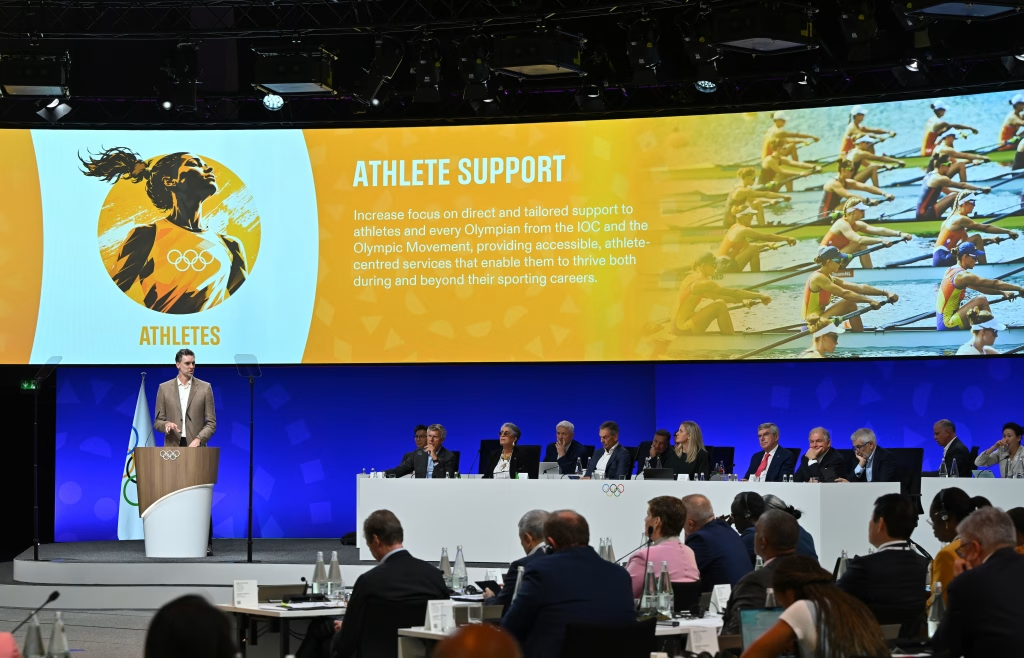
LAUSANNE, SWITZERLAND - JUNE 24: IOC member Pau Gasol holds a speech during the Fit for Future panel part of the 146th IOC Session at SwissTech Convention Centre on June 24, 2026 in Lausanne, Switzerland. (Photo by Chris Ricco - IOC/IOC Collection via Getty Images)
Athlete support has been a top priority for the International Olympic Committee, even more so under new IOC President Kirsty Coventry and Athlete Commission Chair Pau Gasol.
The support was emphasized this morning as the IOC announced a new grant program available for Olympic athletes following each iteration of the games. Beginning with those that competed in the Milano Cortina 2026 Winter Olympics, athletes can apply for a personal grant of $10,000.00 USD that will be distributed by the IOC for personal use. Applications will be facilitated through the Athletes Commission and will open at a later date.
“This is about recognizing the journey and the commitment it takes to become an Olympian,” Gasol said at the 146th IOC Session in Lausanne, Switzerland. “And it is about recognizing that every Olympian is part of our Olympic community, and honoring those who have come before us and paved the way, so that current and future generations of Olympians can benefit.”
The announcement came as part of the “Fit for the Future” plan, which has been a year-long process of ideating the way forward for the Olympic movement. It also comes in the wake of comments made by Coventry in New Zealand, where she said that she opposed the payment of athletes.
“I don’t believe in paying athletes” Coventry told New Zealand’s Sport Nation earlier this month. “I come from a small country, I came from a sport that doesn’t necessarily pay athletes very well and I still don’t think we should be paying athletes at the Olympic Games.”
Coventry later clarified on social media that she was specifically referring to prize money and did indicate that she was open to other means of supporting athletes. She reiterated that position today.
“I’ve always said we need to find direct ways to support athletes,” Coventry said at a media availability following Day 1 of the IOC Session. “That has never changed. It was a little frustrating, obviously, the backlash from New Zealand because also internally I already knew about this. It was like ‘ugh, the timing’s horrible,’ but it is what it is.”
The idea was discussed with athletes through the Athletes Commission, which is the voice of Olympic athletes around the world at the IOC, and has been in progress over the last several years, including during Coventry’s tenure as chair. Gasol explained that throughout the whole process, athletes were given the chance to lend their voice to the discussion.
“We have an opportunity to have global calls, athlete forums at the IOC level [and] the continental level,” Gasol explained. “They came on very, very strong, every time we had a chance to communicate with them.”
The grants come from a pool of $140,000,000 which the IOC has set aside specifically for this purpose, which athletes can use for various purposes. In addition to the sustainable nature of this fund, there were a few considerations beyond affordability for the IOC.
“When I was an athlete, we would have an allotted amount of $5,000 for a qualification event,” Coventry explained. “Most federations would have two world championships, so two very big events, so hopefully they could have $5,000, $5,000 for each of those events.”
For athletes transitioning out of active competition, the grant would still be available to them too.
“The other option that we looked at for an athlete applying for the grant would be life after sport and what that looks like,” Coventry shared. Explaining that the IOC used to work with a business professor, they found that $10,000 “was an acceptable amount everywhere that would allow for someone to start something, or have it as a little bit of seed money.”
The IOC reiterated that it will not diminish any distribution owed to a national Olympic committee.
Athletes are only eligible for the grant if they competed in the Olympic Games immediately preceding the application period and would not be eligible if they violated any anti-doping rule or any provision of the Olympic Charter, including the code of ethics and the conditions of participation. This would likely preclude individuals such as Ukraine’s Vladyslav Heraskevych, who was disqualified from the men’s skeleton competition in Milano Cortina after attempting to wear a helmet on the competition course which had faces of friends who died in the war in Ukraine. The IOC determined that the helmet would have violated the Olympic Charter if allowed on the field of play.
Coventry said that the grant was just one part of the methods of support, and the mission now is to explain how it fits into the big picture.
“How do we take the very exciting news about the grant, and not just explain that to the athletes,” Coventry said of next steps, “but then also share with them all the other opportunities that we’re going to continue to deliver for them.”