When Broadcasting Injuries, Network Judgment Controls
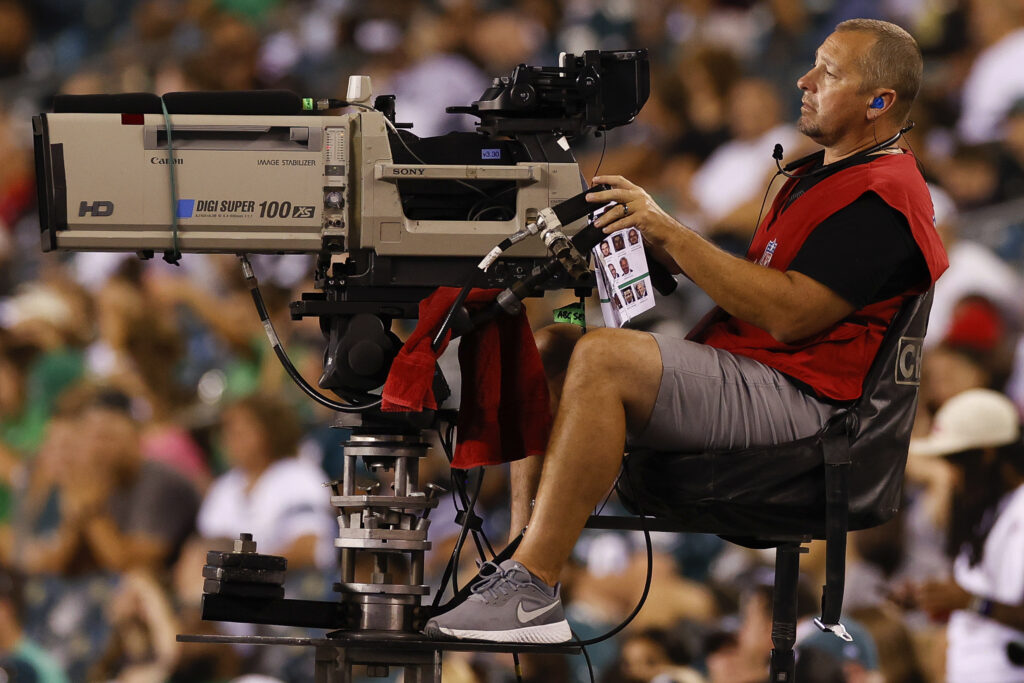
A camera operator during a preseason game between the Philadelphia Eagles and the New England Patriots, Thursday, Aug. 19, 2021, in Philadelphia. (Aaron M. Sprecher via AP)
Fans watching the Monday Night Football matchup between the Pittsburgh Steelers and the Cleveland Browns witnessed Running Back Nick Chubb enduring a significant injury to his left knee. Chubb was carted off the field during the game and will undergo surgery.
The injury, which resulted in his left knee bending nearly 90 degrees to its left at the joint, was so gruesome that commentators Joe Buck and Troy Aikman indicated on air that the broadcast would not replay the injury.
“I am told that the replay of Nick Chubb getting injured is not to be seen,” Buck told ABC viewers.
“Yeah, we’re not going to show it,” Aikman chimed in. “It’s as bad as you can imagine.”
As Buck and Aikman shared this, the broadcast did pick up fan reaction to the replay being shown at Acrisure Stadium in Pittsburgh, which almost served to confirm the decision as the fans almost universally gasped during the replay.
The discrepancy between what was shown on the broadcast and what was replayed in the stadium led some to question that decision.
“You have to show it again to at least put it in context of what happened there,” commented Dan Patrick, host of The Dan Patrick Show on Peacock. “I would have done it. I would have done it once. Because you’re carrying the game. You owe it to the audience. And you could do a disclaimer.”
Others praised the decision to not air the replay.
“Gruesome doesn’t even to begin to describe the Nick Chubb injury,” Pit Viper Media Indiana, which covers mostly high school sports, tweeted on Monday night. “Credit to ABC/ESPN for not showing the replays.”
Birds Nest Media reached out to game broadcast networks for official comment regarding their approach to broadcasting injuries. NBC Sports declined comment. CBS, FOX, ESPN, and Prime Video did not respond with official comments.
According to those familiar with NFL broadcasts, the approach is reasonably consistent across networks. Ultimately, the producer decides if an injury is replayed on air.
“These decisions are made split-second,” shared one source, who spoke on condition of anonymity as he could not speak officially on the topic. “All of them happen as the play ends and the next begins. Decisions on any replay are made within seconds.”
Specifically, the on-site producer makes these calls. Producers have several resources available, including seasoned staff in the production truck constantly looking at different camera angles.
The on-air commentators can also use technology in the broadcast booth to weigh in. One industry source indicated that, especially when they have extensive broadcasting or NFL experience like Buck and Aikman, their insights can be helpful.
Since the decision needs to be made quickly, an off-site producer or executive almost never gets involved. Only in extraordinarily rare injuries or circumstances would this occur, such as last season’s injury to Buffalo Bills Safety Damar Hamlin.
Injuries impact the game differently, and depending on how each does, the producer might make different decisions for each injury, especially if showing it helps the audience understand the game.
“If, for example, Chubb fumbled on the play, a different decision might be made,” one source familiar with broadcasting NFL games said. The source also shared that the overwhelming majority of injuries are replayed.
Tom Grossi and Brandon Perna, hosts of the popular Grossi Perna Show on YouTube, discussed whether the NFL or the NFL Players Association should have input on injury replays on Wednesday’s show.
“If players come out and say, ‘We don’t ever want to see a replay of our injury during the game,’ then I think it’s their decision,” Perna remarked, “and I don’t think that conversation’s ever happened between the NFL and the NFLPA and how it’s broadcast.”
“They [the NFL and its teams] have the use of their name, their image, what have you,” Grossi countered. “When you sign your contract, I imagine that’s what that’s going to look like.”
An NFLPA spokesperson confirmed that the NFLPA has no input into how injuries are broadcast given how quickly the decision must be made. A request for comment from an NFL spokesperson about the NFL’s involvement, and the approach to replaying injuries in stadiums, went unanswered.
The NFL, teams, and broadcasters do meet during the week leading up to the game for production meetings. An industry source indicated that injuries are discussed during these meetings at a very high level, while leaving it to the producer to make a case by case decision.
“It’s [the collaboration] not done in a hard-handed or Big Brother kind of way,” the source said, suggesting it’s more of a partnership, with each party understanding the needs of the other.
Injuries are newsworthy events that are covered long after the player sustains the injury, so it’s sensible to not outright restrict their rebroadcast in a game. Simultaneously, speculating on the injury before the nature is confirmed is inappropriate as it could be inaccurate. The sideline reporter’s injury update often comes at least a drive, if not longer, following the injury, and only comes once the information is known by the team. As injury reports are governed by the NFL’s Integrity of the Game initiative, according to the NFL’s Media Access Policy reviewed annually with teams and the Pro Football Writers of America, injury information will eventually be officially released.
Studio shows are different, as they can have longer conversations about injuries that occur in game that the game’s producers cannot have, and a content warning can be more seamlessly delivered. Additionally, unlike the in-game producers, those involved in studio shows know more about the injury and its aftermath before the show is broadcast.
This consideration impacted how networks covered New York Jets Quarterback Aaron Rodgers’ week one injury. While replays showed that a pop is visible that was likely the Achilles tear he sustained, the broadcast did not specifically highlight the pop in the way that many studio shows did following the game, when it was known that Rodgers sustained a leg injury.
The broadcast of injuries, and even hard hits, has definitely changed over the last several years. Images of Chubb’s injury can be found on the internet with relative ease, which makes a replay less essential. Meanwhile, many Eagles fans still fondly remember the “Body Bag Game,” a matchup between the Eagles and the Washington Redskins in 1990 that resulted in nine injuries to Washington players.
An industry source indicated that while you can always reverse course and broadcast a replay later, you cannot do the reverse. Though the approach may have changed, it’s responsive to how the football world treats this important topic.
As the source pointed out, “it [the change] reflects a change in how fans consume the game.”